




If you thought the transition from PCIe 4.0 to Gen 5 was groundbreaking, the storage industry is already gearing up for the next massive leap. While many consumers are still struggling to find or afford high-end Gen 5 SSDs, Kioxia has officially introduced its first PCIe 6.0 enterprise solid-state drives.
Boasting unimaginable data transfer rates and an architecture designed specifically to feed the insatiable data appetite of artificial intelligence, Kioxia’s latest breakthrough undoubtedly represents the fastest SSD speed the industry has ever witnessed. But there is a catch: these blistering speeds are not intended for your next gaming PC. Instead, they are strictly targeted at enterprise data centers and heavy-duty AI servers.
This shift raises an important question about the current state of consumer technology. Are regular tech enthusiasts being left behind in the race for extreme performance?
The Leap to PCIe 6.0: Redefining Storage Performance
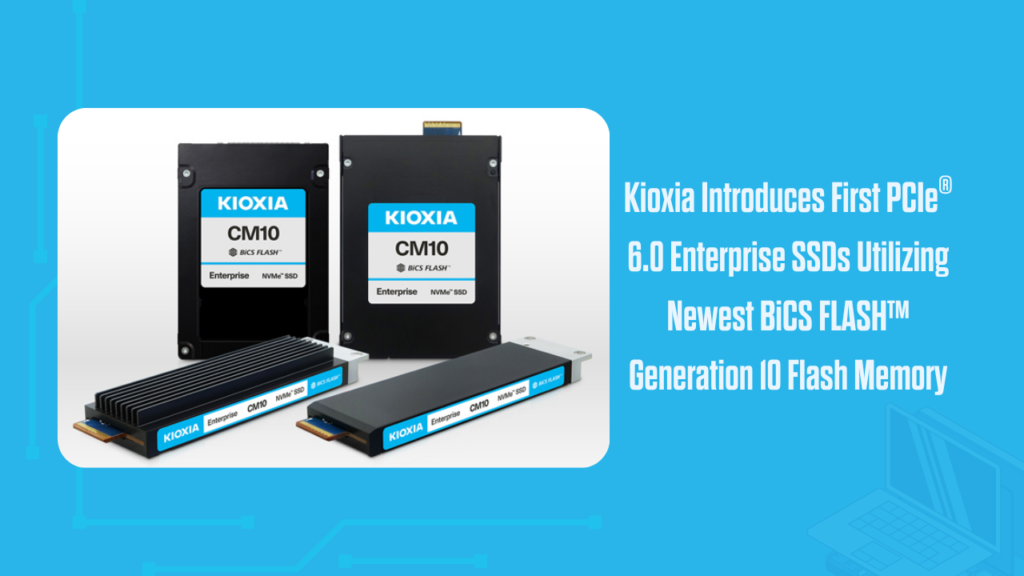
When we talk about the latest NVMe storage, the numbers can quickly become staggering. PCIe Gen 5 SSDs already push sequential read and write speeds up to 14,000 MB/s. However, Kioxia’s new PCIe 6.0 models—specifically their newly unveiled CM10 Series and the GP1 Series—take these metrics into an entirely different stratosphere.
Utilizing advanced memory chips (such as their BiCS Flash generation 10) and PCIe 6.0 NVMe 2.1 standards, these drives deliver nearly double the sequential and random read performance over the previous generation. The GP1 Series, specifically designed for direct GPU access, is capable of reaching a mind-blowing 10 million random read IOPS (Input/Output Operations Per Second).
To put that into perspective, the fastest SSD speed available to consumers right now barely scratches a fraction of that IOPS capability.
Why is this speed necessary?
- Bottleneck Elimination: High-end GPUs processing massive AI models cannot afford to wait for data.
- Direct GPU Access: Modern architecture allows the GPU to bypass the CPU and pull data straight from the NVMe storage, requiring extreme bandwidth.
- Massive Datasets: Training Generative AI requires ingesting petabytes of data simultaneously.
Why AI Servers Are Getting the Fastest SSD Speed First
The driving force behind this rapid innovation isn’t better video game load times or faster video rendering for desktop users. The catalyst is Artificial Intelligence.
AI servers require continuous, rapid-fire access to massive neural network parameters. If the storage drive is too slow, the incredibly expensive AI GPUs sit idle, wasting time and millions of dollars in compute resources. Because of this, companies manufacturing AI infrastructure demand the absolute fastest SSD speed possible, heavily incentivizing manufacturers like Kioxia to cater to the Business-to-Business (B2B) enterprise sector.
In the eyes of hardware manufacturers, the enterprise sector is where the demand—and the budget—currently resides.
The Enterprise vs. Consumer Divide
This announcement highlights a growing frustration within the consumer market. Hardware enthusiasts are feeling the pinch as manufacturers prioritize B2B AI enterprise solutions over consumer hardware.
We are currently seeing a paradigm shift where regular buyers are effectively being sidelined. The sentiment is clear: If you aren’t building an AI server, you aren’t the priority.
However, this aggressive B2B focus introduces a long-term economic risk for the tech industry:
- The Consumer Ecosystem: Ultimately, businesses exist to serve consumers. Whether it’s an AI-generated service, cloud computing, or content delivery, the end-user is a consumer.
- Hardware Accessibility: If high-performance devices become unaffordable or inaccessible to the average user, consumer pocket sizes will not grow.
- The Feedback Loop: If consumers lack the devices necessary to utilize the services these massive AI servers are creating, who will the businesses sell their services to? A B2B market cannot sustain itself indefinitely if the consumer market collapses underneath it.
What Does This Mean for the Average PC Builder?
While it might be disheartening to know that the absolute fastest SSD speed is locked behind enterprise paywalls, there is a silver lining for everyday users.
Enterprise technology eventually trickles down to the consumer market. Just as PCIe 4.0 and 5.0 started in data centers before hitting standard motherboards, PCIe 6.0 will eventually find its way into consumer electronics. For now, PC builders should focus on maximizing their current Gen 4 or Gen 5 setups.
Actionable Advice for PC Builders Today:
- Don’t wait for Gen 6: PCIe 6.0 consumer motherboards and drives are still years away. Do not delay a PC build waiting for this technology.
- Optimize what you have: Ensure your current Gen 4 or Gen 5 NVMe drive is installed in the primary M.2 slot closest to your CPU for maximum bandwidth.
- Ensure proper cooling: The faster the drive, the hotter it runs. Always use a dedicated M.2 heatsink to prevent thermal throttling.
Key Takeaways
- Kioxia has announced its first PCIe 6.0 enterprise SSDs, representing the fastest SSD speed available in the tech industry today.
- These drives can reach up to 10 million IOPS, designed specifically to feed data-hungry AI servers and GPUs.
- The storage industry is heavily pivoting toward the B2B enterprise market, leaving consumer technology temporarily lagging behind.
- While B2B is highly profitable now, neglecting the consumer hardware market poses a long-term risk to the tech ecosystem.
Frequently Asked Questions (FAQs)
1. What is the fastest SSD speed currently available?
For the enterprise market, Kioxia’s PCIe 6.0 SSDs are setting the benchmark, reaching up to 10 million IOPS for random read performance. In the consumer market, Gen 5 SSDs top out around 14,000 MB/s sequential read speeds.
2. What is PCIe 6.0?
PCIe 6.0 is the next generation of the Peripheral Component Interconnect Express standard, offering double the bandwidth of PCIe 5.0, allowing for unprecedented data transfer rates.
3. When will PCIe 6.0 SSDs be available for normal PCs?
Currently, PCIe 6.0 technology is strictly for enterprise data centers and AI servers. It will likely be several years before consumer motherboards and SSDs fully adopt the standard.
4. Why do AI servers need such fast storage?
AI processing requires constant access to massive datasets. If the storage is slow, the highly expensive GPUs sit idle waiting for data, which wastes both time and money.
5. Is Kioxia the only brand making PCIe 6.0 SSDs?
While Kioxia is leading the charge with their recent announcements, other major memory manufacturers like Samsung and Micron are also heavily developing PCIe 6.0 enterprise solutions.
6. Do I need a PCIe 6.0 SSD for gaming?
No. Current games do not even fully utilize the speed of PCIe 4.0 SSDs. A Gen 6 drive would offer no noticeable improvement in modern gaming load times.
7. How much faster is PCIe 6.0 compared to PCIe 5.0?
Theoretically, PCIe 6.0 doubles the bandwidth of PCIe 5.0, providing roughly a 92% increase in sequential read performance.
8. Can a consumer buy an enterprise SSD?
While technically possible to purchase them through specialized vendors, enterprise SSDs use different form factors (like E1.S or E3.S) and protocols that are not directly compatible with standard consumer desktop motherboards.
9. Will my PCIe 4.0 motherboard support a PCIe 6.0 SSD?
PCIe standards are generally backwards compatible, but the drive will bottleneck and only run at the maximum speed supported by your motherboard’s PCIe 4.0 interface. Furthermore, enterprise form factors likely won’t physically fit consumer boards.
10. How hot do PCIe 6.0 SSDs get?
Because of the massive data throughput, they generate significant heat. Kioxia’s enterprise models even support direct liquid cooling to manage the thermal output.
11. What is IOPS?
IOPS stands for Input/Output Operations Per Second. It measures how many read and write requests a storage device can handle every second, which is crucial for handling multiple small files rapidly.
12. Why are consumer SSDs falling behind?
Manufacturers are focusing their research and development budgets on the enterprise AI market because that is where the immediate, massive financial demand currently exists.
13. What is BiCS Flash generation 10?
It is Kioxia’s proprietary high-density 3D NAND flash memory technology used in their latest enterprise SSDs to achieve higher capacities and faster speeds.
14. What happens if businesses only focus on B2B?
If tech companies ignore consumers, the end-user base may lack the hardware necessary to interact with the high-end software and AI services the enterprise servers are producing, potentially harming the overall market economy.
15. Should I upgrade from Gen 4 to Gen 5 SSD right now?
Unless you routinely transfer massive files for video editing or heavy data processing, sticking with a high-quality Gen 4 SSD is currently the most cost-effective choice for general consumers and gamers.
Link to: Kioxia’s Official APAC Press Release